 kultura sjećanja / remembrance culture
“Architecture of a Young Warrior” - Maksym Kozlov
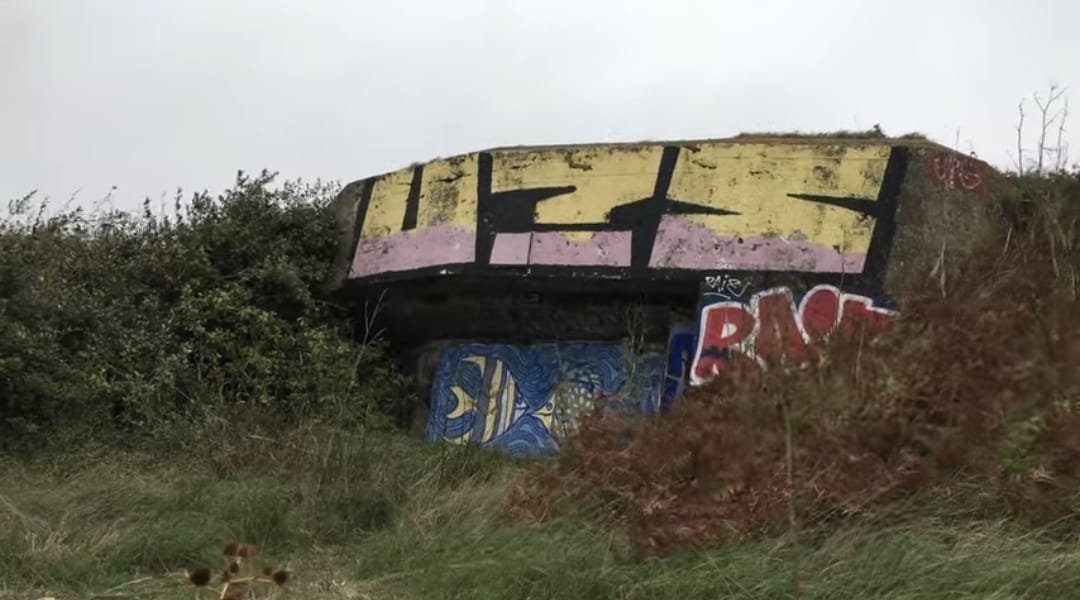
The installation “Architecture of a Young Warrior” takes place on the coast of the Saint-Nazaire Pocket, which was part of the so-called Atlantic Pocket that existed from August 1944 until 11 May 1945. It was formed by the withdrawal of German troops from Loire-Inférieure (now Loire-Atlantique) during the liberation of the department by the Allied forces in western France.
Within the framework of ''(In)Visible Traces. Artistic Memories of the Cold War'', the artist was inspired by the research and theory of Bunker Archaeology, developed by Paul Virilio after World War II, which examines the coastal defense architecture along the Atlantic Ocean and traces its influence in the postwar environment of “everyday life.” The artist found the bunkers resting in the embrace of plants and trees, slowly reclaimed by nature over the years following their military use.
The artist began to imagine simple, invisible geometric molds in plaster as symbolic echoes of the bunkers’ brutal forms. Cylinders, squares, cubes, and other shapes take on a speculative role as points of defense—structures that might deflect a bullet or camouflage the blockhouse by reflecting the blue color of the ocean before it. The old, grass-covered rooftops of the bunkers serve as the installation sites, and the work itself is visible only from above, playing with the imagined possibility of reinventing the military function of these old “brutal” infrastructures in the current turbulent political climate, reminding viewers of the complexity of the story that originally unfolded around these structures during WWII.
_______________
Maksym Kozlov is a multidisciplinary artist who works at the intersection of visual anthropology and spatial poetry. He was born in Melitopol, Ukraine, in 1998. At that moment, in the aftermath of the full-scale Russian invasion of Ukraine in 2022, he redirected his focus toward public art, studying in France (currently at the Fine Arts School of Le Mans).
His practice delves into the reflection of art in public spaces, drawing inspiration from the metabolism of history and questions surrounding the spatial representation of power. It highlights itself in the processes of creating sculptures and documentary photography. Kozlov’s artistic activity is centered on the poetic exploration of economy, through which he analyzes historical interrelationships, addressing both theoretical concepts and field studies.
His projects have been featured in international magazines, including Zeit Magazine, Kajet, Calvert Society, Bird in Flight, and WePresent.
Currently, he resides and works in La Baule-Escoublac, France.
_______________
Artistic interventions are part of the Creative Europe project ''(In)Visible Traces. Artistic memories of the Cold War''.
Funded by the European Union. Views and opinions expressed are however those of the author(s) only and do not necessarily reflect those of the European Union or the European Education and Culture Executive Agency (EACEA). Neither the European Union nor EACEA can be held responsible for them.